

Home EV charger installation is usually straightforward when you ask the right questions first: can your panel support the load, do you need a 240 V circuit, and where should the charging station and charger go. Most expensive surprises come from electrical capacity limits and long wiring runs, not from the charger itself.
Key Takeaways
- A home EV charger installation usually works best with a Level 2 charger on a dedicated 240 V circuit, but the first decision is whether your electrical panel has enough capacity and breaker space.
- The U.S. Department of Energy says Level 2 home charging is commonly installed for overnight charging, and NEC Article 625 commonly ties it to a dedicated 40-amp circuit with equipment-specific sizing.
- Older homes often have 100 amp panels, while many newer homes have 200 amp panels; if capacity is tight or breaker space is full, a panel upgrade may be needed before EV charger installation.
- Installation cost is driven more by the distance from the panel to the charger location, conduit or trenching, and panel work than by the charger hardware itself.
- If you want the most practical setup, compare Level 1 vs. Level 2, confirm hardwired vs. outlet requirements from the charger manufacturer, and get a licensed electrician to perform a load calculation and permit-ready site review.
For most drivers, a Level 2 charger is the practical home setup because it can recharge a typical EV overnight. The smartest pre-installation plan checks panel amperage, breaker space, charger location, dedicated circuit needs, and local permit requirements together instead of treating them as separate decisions.
Do I need a Level 2 home EV charger, or is Level 1 enough?
Usually, yes: most daily drivers are better served by Level 2 charging. The Department of Energy says EVs can charge on 120 V Level 1, but 240 V Level 2 is commonly installed at home for overnight charging.
Level 1 works when driving needs are modest and the vehicle sits parked for long stretches. It is the slowest option, though, and that gap matters quickly if you commute daily or need dependable overnight recovery after a low battery day.
Level 2 is the usual answer when convenience matters. It generally requires a 240 V connection, and DOE guidance points to a dedicated 40-amp circuit under NEC Article 625 for common home setups. A common misconception is that every Level 2 charger will charge every EV at the same speed. Your vehicle’s onboard charger can limit the actual charging rate, so the best choice is the charger and circuit size that match both the car and the house.
Does my electrical panel have enough capacity for EV charger installation?
Panel capacity decides the project. DOE guidance highlights 100 amp panels, 200 amp panels, and available breaker space as the first checks before adding an EV charger.
There are really two questions here. First, do you have physical space for a new 2-pole breaker? Second, can the service safely handle the added continuous load? DOE’s home electrification guidance notes that many modern homes have 200 amp panels, while older homes often have 100 amp panels.
A common mistake is assuming two empty breaker spaces mean the house is ready. If the load calculation is tight, the safe answer may be a panel upgrade. If your home also has electric HVAC, an electric water heater, a range, or a pool pump, those loads matter just as much as the EV charger.
“Pinellas County Electric specializes in panel upgrades from 100 amp to 200 amp when EV chargers and other major loads need more capacity.”
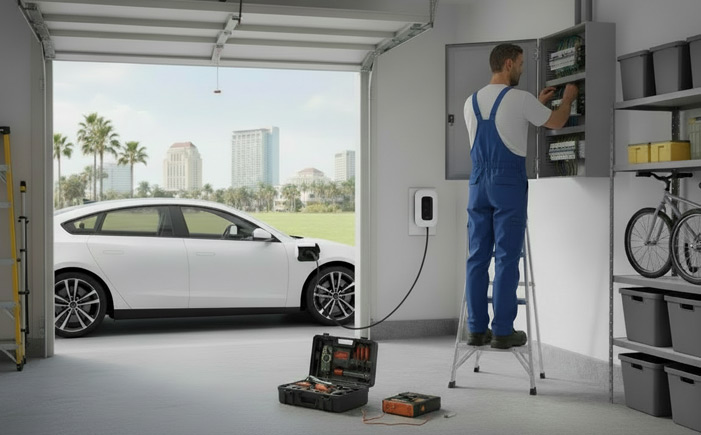
What are the best home EV charger installation options in Pinellas County?
The best option is a licensed electrician who can evaluate panel capacity, permit needs, and charger placement in one visit. In Pinellas County, that usually means comparing local EV charger specialists, full-service electrical contractors, and installer networks tied to charger brands or dealerships.
The right fit depends on home age, panel condition, and whether the project is a simple garage install or a larger electrical upgrade.
- Pinellas County Electric: A local residential and commercial contractor with EV charger installation, panel upgrade, and older-home electrical experience across Pinellas County.
- Full-service electrical contractors: A solid fit when the EV charger may be bundled with surge protection, rewiring, lighting, or remodeling work.
- Manufacturer-certified or dealer-referred installers: Useful when your charger brand has preferred installation workflows or warranty documentation requirements.
- Multi-trade firms for complex sites: Best when detached garages, trenching, meter work, or major service changes are part of the scope.
How do I check whether I need a dedicated 240 V circuit?
Most Level 2 chargers do need a dedicated 240 V circuit. DOE and NEC Article 625 commonly tie home Level 2 charging to a dedicated 40-amp circuit, with final breaker and conductor sizing based on the charger’s actual rating and instructions.
Step 1 is to check the charger specifications, not just the marketing page. Look for the required voltage, maximum circuit size, and whether the unit is hardwired or plug-in. If the manufacturer calls for a dedicated 240 V circuit, that requirement is part of the installation, not an optional upgrade.
Step 2 is to look at the panel and the parking location together. If the charger will be mounted far from the panel, the electrical run may affect conduit routing, labor, and voltage drop planning. If there is already a 240 V outlet in the garage, do not assume it is ready for EV charging. Receptacle type, conductor size, breaker size, and code suitability all need to match the charger.
Step 3 is a professional load and circuit review. That confirms the breaker size, wire size, disconnect requirements if applicable, and permit path. This is where small details prevent larger corrections later.
Is a 100 amp panel enough, or do I need a 200 amp panel for home EV charging?
A 100 amp panel can be enough for some homes, but a 200 amp panel gives more flexibility for EV charging and future electrification. The answer depends on actual household loads, not just the panel label.
A 100 amp panel may work if the home is smaller, major appliances are gas, and the load calculation leaves room for the EV charger. If the panel also has open breaker space and the charger size is moderate, installation can be straightforward.
A 200 amp panel is often the better platform when the house already carries several electric loads or is likely to add more later. Think electric dryer, range, HVAC upgrades, hot tub, pool equipment, or a future generator interconnection. DOE guidance says two common reasons to increase panel size are insufficient electrical capacity and not enough physical breaker space. If either problem is present, moving to 200 amps can solve today’s charger question and tomorrow’s upgrade questions at the same time.
The trade-off is clear: a panel upgrade adds cost now, but it can reduce constraints and rework later. If your long-term plan includes more electrification, the panel decision should be made with that full picture in mind.
How should I choose the best location for my home EV charger?
The best location for a charging station is usually close to the electrical panel and close to where the EV parks. Garage walls and driveway-adjacent exteriors often reduce wire length and daily hassle.
Step 1 is to park exactly where the vehicle will charge most often. Measure where the charge port sits relative to the wall, not just where the bumper stops. This avoids a very common mistake: placing the charger where it looks tidy but forces the cable to stretch across walking space every night.
Step 2 is to compare that parking spot with the panel location. Shorter electrical runs often mean lower installation cost and less wall repair. In Florida homes, exterior placement can still work well, but the equipment needs the correct weather rating and mounting method.
Step 3 is to think about daily use, not only installation day. Cord management, lighting, future vehicle changes, and protection from accidental impact all matter. If you may replace your EV in a few years, choose a spot that still works if the next vehicle’s charge port is on the opposite side.
“Pinellas County Electric says EV charger pricing depends heavily on the distance from the electrical panel to the charging location.”
What drives home EV charger installation cost the most?
Distance and panel work usually drive the bill more than charger hardware. Pinellas County Electric and DOE guidance both point to 240 V circuit requirements, breaker space, and service capacity as the biggest variables.
Several cost drivers show up again and again:
- Electrical run length: More wire, conduit, and labor between the panel and charger location
- Panel changes: New breaker space, load calculation issues, subpanel work, or full panel upgrades
- Wall and site conditions: Finished garages, masonry, exterior routing, attic access, or trenching
- Permit and inspection: Local compliance steps that support safety and resale confidence
- Charger type: Hardwired units and outlet-based setups can change material and labor needs
A useful rule is this: if the charger location is simple and the panel is ready, the project is usually straightforward. If the run is long or the panel is undersized, costs rise fast. A pro tip here is to compare total installed cost, not charger sticker price. A cheaper unit mounted in a difficult location can cost more overall than a better unit installed near the panel.
“Pinellas County Electric provides free estimates for EV charger installation, with pricing shaped by panel distance and upgrade needs.”
Should I install a hardwired EV charger or a 240 V outlet?
Hardwired chargers are usually the cleaner long-term choice, while a 240 V outlet can add flexibility. Tesla Wall Connector and NEMA 14-50 style setups are common examples of the two approaches.
A hardwired charger connects directly to the branch circuit. That usually means fewer connection points, a more permanent appearance, and a setup often preferred for outdoor locations or higher-power configurations. If the manufacturer supports higher amperage only in hardwired mode, that point should settle the decision.
A 240 V outlet setup can be attractive when you want the option to swap chargers later or take the charger with you. The trade-off is that the receptacle, plug, and circuit must all be correct for EV use. A common misconception is that any existing dryer outlet can do the job. It cannot unless the outlet type, breaker, conductor size, and location match the charger and current code requirements.
If flexibility is your priority, an outlet may make sense. If durability, weather exposure, and a cleaner install matter more, hardwired is often the better answer.
What happens during a professional installation?
A professional installation follows a clear sequence: site review, load check, permit work, circuit installation, charger mounting, testing, and inspection.
Step 1 is the assessment. The electrician reviews the panel, confirms available capacity, checks breaker space, identifies the charging station location, and verifies whether the equipment will be hardwired or plugged in. This is also where older homes reveal whether the job is a simple circuit addition or part of a broader panel upgrade.
Step 2 is preparation and code planning. That may include a permit application, materials selection, conduit routing, and any panel modifications needed to support the new 240 V circuit. If the home needs a service or panel upgrade first, that work is handled before the charger goes live.
Step 3 is installation and verification. The circuit is installed, the charger is mounted, connections are torqued and labeled, and the equipment is tested. In a properly handled project, the final result is not just that the charger turns on, but that the system is code-compliant, safely protected, and ready for repeat daily use.
“Pinellas County Electric offers free on-site estimates for upgrades and EV charger installation in Pinellas County.”
Which home EV charger questions should I ask an electrician before booking the job?
The smartest questions focus on capacity, circuit design, and total scope. Ask about the panel, the charger, and the route from one to the other.
A productive estimate visit usually answers these questions:
- Panel capacity: Can my existing service safely support this charger?
- Circuit requirements: Does my charger need a dedicated 240 V circuit, and at what breaker size?
- Installation method: Is hardwired or outlet-based better for this charger and location?
- Site design: What is the shortest safe route from the panel to the charger?
- Future planning: If I add another EV or electrify more appliances, what changes later?
If an electrician can answer those questions clearly, the project is moving in the right direction. If the answers are vague, the estimate is missing the technical core of the installation.
Ready to Power Up Your Life?
Don’t let outdated wiring or slow charging hold your property back. Whether you are looking to secure your home in Pinellas Park, upgrade your panel in St. Petersburg, or finally install that high-speed EV charging station, Pinellas County Electric is here to help.
We take the guesswork out of electrical work by providing clear communication, fair pricing, and a commitment to customer satisfaction that has kept our neighbors “fully charged” for years.
We focus on providing high-quality solutions during our standard business hours so you can enjoy your property with total peace of mind.


