
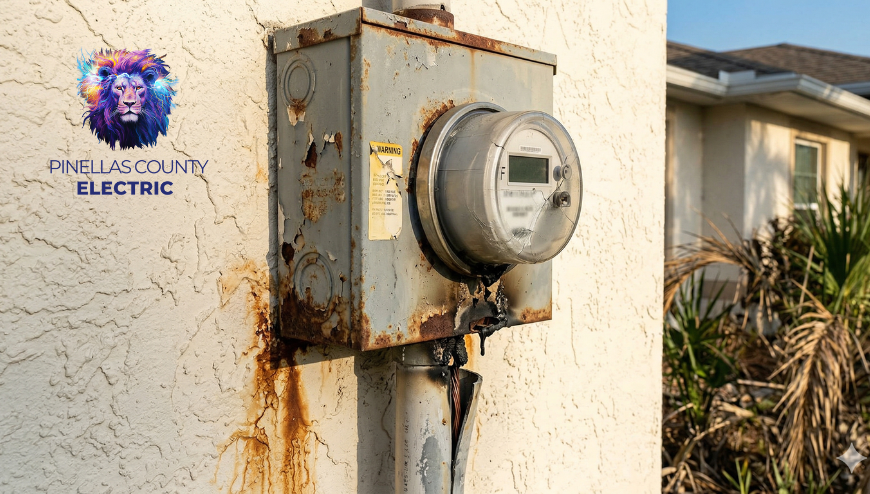
Why Florida Homeowners Can’t Ignore the “Whispers”
Electrical problems in Florida rarely announce themselves with a sudden explosion. They usually start with subtle whispers that many property owners overlook until it is too late. The meter base acts as the physical connection point where power transitions from Duke Energy lines into your specific electrical system.
Because this enclosure sits outside, it is constantly exposed to the elements, leading to failures that can mimic simple breaker trips or appliance issues.
Identifying Common Warning Signs of a Failing Meter Socket
The most common signs a meter base is failing include a faint buzzing or humming sound at the meter, widespread flickering lights, or an air conditioner that struggles to start. In Pinellas County, salt-air corrosion often causes these components to arc and overheat, which can eventually lead to losing power to exactly half of your home.
The Three Most Common Symptoms of a Deteriorating Meter Socket
Mechanical failure within the meter enclosure typically presents in three distinct ways. Understanding these cues can help you schedule Meter Center Maintenance before a total shutdown occurs.
- Audible Buzzing: Electricity should not make noise. A humming or buzzing sound coming from the enclosure usually indicates arcing. This happens when a connection is loose or corroded, forcing electricity to jump across a gap instead of flowing through a tight mechanical bond.
- Voltage Instability: If you notice lights dimming and brightening across multiple circuits simultaneously, the meter connection is likely compromised. This instability can cause sensitive electronics to reset or behave unpredictably.
- HVAC Stress: Your air conditioning system is often the first victim of a bad meter socket. Low or unstable voltage starves the compressor of necessary power, causing it to surge and increase amperage draw, which puts immense strain on the motor.
The “Half-House” Power Loss: A Hidden Meter Connection Issue
One of the most alarming symptoms is when exactly half of a home or building goes dark while the other half stays energized. In a standard single-phase service, power is delivered through two hot legs. If corrosion or mechanical failure kills just one of those legs at the meter base, you lose power to all circuits tied to that leg.
Homeowners frequently mistake this for a main breaker issue, but the root cause is often a failed meter connection.
Pro-Tip: The “Spring Tension” Failure in Florida’s Salt Air
While many people look for visible rust on the outside of the box, the real danger is invisible internal pitting. Florida’s salt-laden air aggressively attacks the aluminum and steel components inside the enclosure.
The Information Gain here is understanding “clamping force”. Inside the base, meter jaws use spring tension to grip the blades of the meter. Over time, oxidation weakens this tension. Once the jaws lose their grip, a tiny gap forms, allowing arcing to start.
This creates a “thermal runaway” cycle: the arc creates heat, heat weakens the metal further, and eventually, the internal plastic housings melt, or the insulation chars before a breaker ever has the chance to trip.
Ownership and Responsibility: Duke Energy vs. The Building Owner
There is a major historical factor that many Pinellas County residents do not realize. Decades ago, the utility company provided the meter base as part of their service. Today, that responsibility has shifted. The building owner is now responsible for providing and maintaining the meter enclosure itself.
- Overhead Service: You are responsible for the utility taps at the top of the pole down through the weatherhead, riser, and meter enclosure.
- Underground Service: While Duke Energy often handles the lateral cables for residential sites, the meter base remains your property.
Knowing this demarcation point helps you understand that you cannot wait for the power company to fix a deteriorating enclosure.
Why Pinellas County Residents See Faster Meter Degradation
Our local environment accelerates electrical failure. Whether you are in Clearwater, Dunedin, Safety Harbor, Largo, Tarpon Springs, Palm Harbor, or Pinellas Park, salt air is a constant threat. Humidity and salt accelerate the oxidation of internal lugs and bus connections.
These are not lifetime devices; they are mechanical systems that degrade over time.
FAQs
Is a buzzing meter dangerous?
Buzzing indicates arcing, which generates intense heat. This can melt internal components and ignite surrounding materials, posing a severe fire risk to your exterior walls.
Why are only half of my lights working?
If one of the two hot legs in your service fails at the meter, half your circuits will lose power. This is often caused by a corroded lug or a weakened meter jaw.
Does Duke Energy repair my meter box?
While they own the glass meter, the building owner is responsible for the meter base enclosure and the internal components, like lugs and bus bars.
What causes widespread flickering in my house?
When a meter base connection is compromised, it causes voltage instability that affects multiple circuits simultaneously. This is a primary warning sign of a failing meter socket.
Protect Your Property with Pinellas County Electric
Do not wait for a whisper to turn into a total shutdown. If you hear buzzing, see flickering, or lose half your power, your electrical system is speaking to you. Early evaluation can prevent catastrophic damage to your appliances and your home.
Contact Pinellas County Electric to schedule a professional evaluation of your Meter Center Services today.


