
Clearwater homeowners usually need an electrical panel replacement when the existing panel is unsafe, obsolete, or damaged, and an electrical panel upgrade when the home also needs more electricity capacity for today’s loads. The difference matters because one solves equipment reliability, while the other changes what the home can safely power.
Key Takeaways
- For Clearwater homes, electrical panel replacement means swapping unsafe or worn service equipment, while an electrical panel upgrade usually increases capacity, often from 100 amps to 150 or 200 amps, to support modern loads.
- Florida generally requires a permit before replacing or altering electrical equipment, except for limited emergency situations where the permit application follows on the next working business day.
- Common warning signs include flickering lights, frequent breaker trips, crackling sounds, burning smells, and obsolete brands like Federal Pacific or Zinsco.
- Panel work can affect more than safety: Florida property insurers and Florida-licensed inspectors review the electrical system, so panel condition may matter during underwriting or policy review.
- A like-for-like replacement is often enough when capacity is adequate and the problem is the panel itself; if the home is adding EV charging, new HVAC, a range, or major remodeling, an upgrade is usually the better fit.
That is why panel work in Clearwater is not just a repair choice. It is a permitted safety decision tied to code compliance, insurance scrutiny, and whether you need to replace your electrical setup so that an older Florida home can support real-world electrical demand without nuisance trips or hidden heat buildup.
What is the difference between electrical panel replacement and panel upgrade?
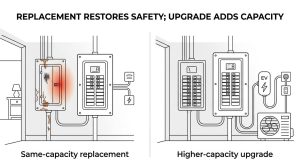
A panel replacement swaps old equipment for new equipment, while a panel upgrade increases electrical capacity or service size. In Clearwater, Eaton or Square D equipment might replace a failing panel, but a move from 100 amps to 200 amps is an upgrade, not just a replacement.
A replacement is usually chosen when the panel has reached the end of its safe service life, shows damage, or belongs to a problem-prone obsolete brand known for breaker issues, which may involve coordination with the utility company for service adjustments. The home may keep the same service size if the load is still appropriate and there is enough circuit space.
Side-by-side view of an electrical panel replacement versus a panel upgrade, showing same-capacity swap on one side and increased service capacity on the other.
An upgrade is about demand, which often requires higher amperage to accommodate the increased electrical load. If the house now carries central air, kitchen remodel loads, a pool system, an EV charger, or needs an upgraded power supply, the service may require more amperage, additional breaker spaces, and increased voltage. A common misconception is that a larger panel automatically fixes every electrical issue. It does not. If branch circuits, wiring methods, or grounding are deficient, those conditions still need attention.
When is electrical panel replacement the safer choice in Clearwater homes?
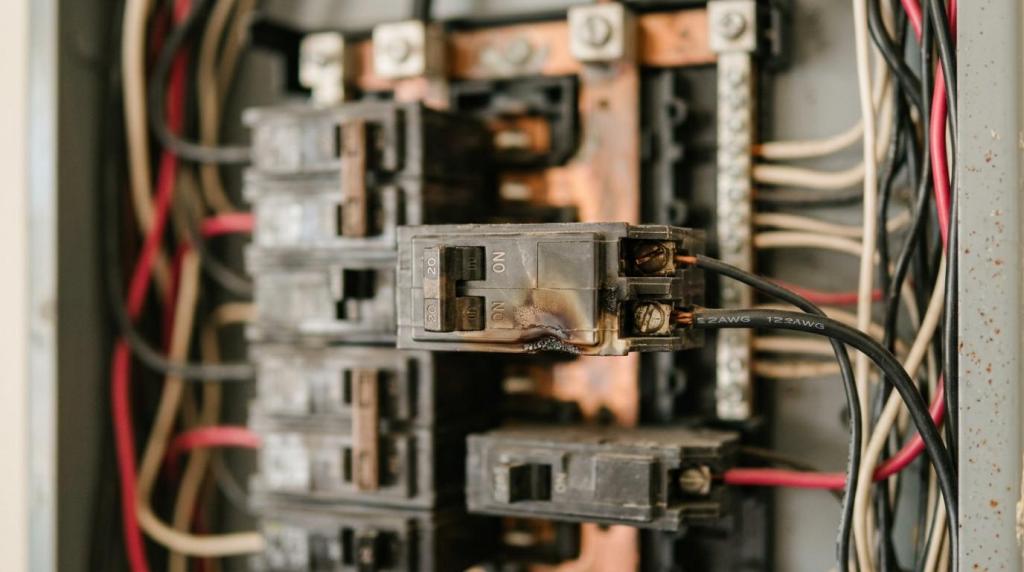
Professional panel replacement is the safer choice when the existing equipment is damaged, overheating, obsolete, or unreliable. Federal Pacific and Zinsco breaker panels are well-known examples that often trigger replacement discussions in Clearwater.
If breakers trip repeatedly under normal use, the panel feels warm, or lights flicker when a large appliance starts, the issue may be due to an overloaded circuit or excessive load, indicating more than nuisance behavior. It can point to loose terminations, overloaded circuits, aging breakers, or internal bus damage. Burning smells and crackling sounds raise the urgency because heat and arcing are not maintenance issues. They are warning signs.
Moisture, like a circuit breaker malfunction, matters too. In coastal Pinellas County, corrosion around the panel or meter equipment can shorten equipment life and compromise connections. If there is visible rust, water intrusion, or evidence that the enclosure has been exposed to repeated humidity or leaks, replacement often becomes the cleaner and safer path than repeated spot repairs.
“Pinellas County Electric flags flickering lights, frequent breaker trips, crackling sounds, burning smells, and Federal Pacific or Zinsco panels as warning signs for evaluation.”
NFPA research continues to track home fires caused by electrical failure or malfunction, which is why electricians treat these symptoms seriously. If the panel is hot, smoking, or producing a strong burnt odor, shut off power only if it is safe to do so and call a licensed electrician immediately. Repeatedly resetting a tripped breaker is a common mistake because it can mask a worsening fault.
What are the most common signs your electrical panel needs attention?
Frequent breaker trips, visible damage, and obsolete brands are the clearest signs. Clearwater homeowners should treat these symptoms as reasons for a licensed inspection, not as proof that every panel needs replacement.
After a site review, many issues fall into one of three buckets: isolated circuit repair, panel replacement, or full service upgrade. The signs below help separate routine annoyance from a real safety concern.
- Breakers trip often: especially when air conditioning, a microwave, or a dryer starts.
- Lights flicker or dim: this can point to load strain, loose connections, or deteriorating equipment.
- The panel smells burnt or crackles: arcing and overheating deserve immediate attention.
- The enclosure shows rust, staining, or heat marks: corrosion and heat discoloration are never normal.
- The panel is Federal Pacific or Zinsco: many electricians recommend close evaluation because of long-standing safety concerns.
- The home has outgrown the panel: added appliances, EV charging, and remodel work often reveal a capacity problem rather than a single bad breaker.
How does a licensed electrician decide whether to repair, replace, or upgrade a panel?
The decision starts with load and condition, considering the cost of replacing an electrical panel, not guesswork. In Clearwater homes, the electrician looks at service size, panel brand, circuit behavior, grounding, and the actual connected loads.
Step 1 is to review how the home uses power now, which forms the basis for any required electrical installation changes. That means looking at HVAC tonnage, water heating, cooking equipment, laundry loads, pool equipment, and planned additions like an EV charger. If the calculated demand reasonably fits the existing service, a full ampacity upgrade may not be needed.
Step 2 is the physical inspection. The electrician conducts a professional check of the panel interior, breakers, bus bars, grounding and bonding, electrical installation, conductor terminations, corrosion, heat damage, available spaces, and the condition of the meter can, service entrance conductors. If the panel is obsolete, damaged, or crowded with tandem breakers used as a workaround, or if the incorrect voltage is present, replacement becomes more likely, and homeowners should consider the cost of replacing an electrical panel when evaluating options.
Step 3 is choosing the least invasive safe fix. If the issue is a single failed breaker or one defective circuit and the panel is otherwise sound, a repair may be enough. If the panel is unsafe but the load is still appropriate, replacement fits.
Should the house exceed the practical limits of the current service, an upgrade to a panel with higher amperage is the better answer. A useful rule is simple: if demand is the problem, replacement alone will not solve it.
How much does electrical panel replacement or upgrade usually cost in Clearwater?
Costs vary widely because amperage, code corrections, and utility company coordination all change the scope. In Clearwater, a like-for-like panel replacement is usually less expensive than a 200-amp service upgrade.
As a ballpark, many homeowners in Florida see straightforward panel replacements land in the low-thousands, while service upgrades commonly start higher and can move well beyond that when meter work, service entrance conductors, grounding upgrades, or circuit corrections are required. Older homes can fall outside broad ranges because hidden conditions, such as varying load requirements, are common once the panel is opened.
The best way to compare estimates is to compare scope, breaker type, not just price. One quote may include permit fees, grounding updates, surge protection, labeling, and inspection coordination, while another may not.
- Service size: 100-amp replacement is different from a 200-amp service upgrade.
- Existing condition: damaged conductors, corrosion, and overcrowded circuits add labor.
- Code-related work: grounding, bonding, GFCI or AFCI updates may be required in connected work areas.
- Utility coordination: meter can changes or service entrance work can add time and cost.
- Home type: older houses, mobile homes, and multi-unit properties often need extra evaluation.
A practical tip is to ask whether the quote is truly like-for-like, and check if the circuit breaker is included at no extra cost. A very low number can leave out permit handling or needed code corrections.
Is panel replacement different from a service upgrade to 200 amps?
Yes, and the distinction is important. A panel replacement can keep the same service size, while a 200-amp upgrade often changes the panel, service conductors, breaker, meter equipment, and utility coordination, making it a good time to replace your electrical system if it’s outdated.
If a 100-amp home only has an unsafe or obsolete panel, replacing it with modern equipment may restore safe operation without changing the service size. If the same home is adding a Level 2 EV charger, larger HVAC equipment, an induction range, or a workshop, a 200-amp upgrade often makes more sense because those loads can stack quickly.
This is where homeowners sometimes get confused. More breaker spaces are not the same as more available power. A new panel with lots of spaces still cannot exceed the ampacity of the service feeding it. If the service conductors and utility connection remain sized for 100 amps, the house is still a 100-amp home.
Highlighted quote reading that more breaker spaces are not the same as more available power.
“Pinellas County Electric provides both panel upgrades and full panel replacements in Pinellas County, which matters when a home needs either same-capacity replacement or added electrical capacity.”
What happens during a permitted electrical panel replacement in Florida?
Florida treats panel replacement as regulated electrical work that requires a permit in normal circumstances. The process usually includes permitting, shutdown and replacement, then inspection and testing.
Step 1 is defining scope and pulling the permit. The Florida Building Code requires a permit before installing, altering, repairing, removing, converting, or replacing regulated electrical systems or equipment, except in an emergency where the application follows on the next working business day. That matters because homeowners should expect approved work, not an informal swap.
Step 2 is the field work. Power is shut down, circuits are identified, breakers and the old equipment are removed, and the new panel is installed with updated power supply, terminations, labeling, grounding, and bonding. Depending on the condition of the home, the electrician may also need to address the meter can, service mast, grounding electrodes, or circuit organization.
Step 3 is inspection and final verification. The work is reviewed for code compliance, then the system is tested so breakers, connected loads, and safety functions operate as intended. If you are planning remodel work soon, it often makes sense to discuss panel needs before walls are closed.
Why do older Clearwater homes and mobile homes face different panel risks?
Older Clearwater homes and many mobile homes present different electrical limits. Age, original load assumptions, aluminum wiring details, and service equipment layout all shape the panel decision.
Many older homes in Clearwater and St. Petersburg were built when electrical demand was far lower than it is today. A house that once handled lighting, a refrigerator, and a few window units may now support central HVAC, multiple televisions, kitchen appliances, computers, and electric vehicles (EV) charging, significantly increasing its electricity demand. The panel may not be the only issue, but it is often the choke point.
Some homes also have aluminum branch circuit wiring or older termination methods that deserve special attention during panel work. In those cases, the panel project can intersect with connector upgrades, including AlumiConn-style remediation where appropriate. Mobile homes add another wrinkle because service equipment configuration can differ from a site-built house, and code-compliant replacement may require a closer look at feeders, disconnects, and grounding.
“Pinellas County Electric notes that many older Clearwater and St. Petersburg homes were wired for a fraction of today’s electrical use.”
A common misconception is that if an older panel still turns the lights on, it is fine. Electrical equipment can remain functional while still being undersized, obsolete, or one fault away from failure.
How can electrical panel condition affect Florida homeowners insurance?
Panel condition can matter during underwriting because Florida insurers inspect the electrical system. A Florida-licensed inspector may review the home’s electrical components as part of policy evaluation.
This does not mean every older panel causes a denial or premium change. It does mean the panel becomes part of the risk picture. Citizens states that an inspector checks the electrical system, along with plumbing, HVAC, and roof conditions, and may even contact the utility company for additional insights. The Florida Office of Insurance Regulation also frames home age and condition, including the state of the breaker and electrical installation, as factors that affect coverage and policy structure.
For Clearwater homeowners, the practical takeaway is simple: understanding the cost of replacing your electrical panel can be crucial when evaluating options. If the home has a documented obsolete panel, visible deterioration, or clear safety defects, replacement can remove an underwriting concern and support a stronger inspection file. That is different from guaranteeing a discount on breaker replacements. Unlike wind-mitigation features, a new panel is not a universal premium reduction tool.
If you are buying an older home, ask early whether the panel brand, age, and condition are likely to trigger questions. It is easier to plan a permitted replacement before a closing delay or post-bind inspection issue lands in your inbox.
FAQs
What is the difference between electrical panel replacement and upgrade?
A replacement involves swapping out your existing breaker panel for a new one of similar capacity, often due to age, damage, or safety concerns. An upgrade increases your panel’s capacity to handle more circuits or higher electrical loads, including higher amperage, which is essential if you’re adding major appliances or expanding your home.
What are common warning signs that my electrical panel needs attention?
Look for flickering lights, frequent breaker trips, burning smells, buzzing sounds, scorch marks, or a panel that feels hot to the touch, as these could indicate a voltage issue. These are signs you should call a licensed electrician immediately.
How much does electrical panel replacement cost in Clearwater, FL?
Costs, including the cost to replace an electrical panel, can vary based on the size of your home, the complexity of the job, and the type of panel needed. On average, homeowners can expect to pay between $1,500 and $3,500 for a standard replacement or upgrade. For an accurate quote, contact Pinellas County Electric for a personalized assessment.
Is it safe to keep using an old electrical panel?
Older panels, especially those over 25 years old or with outdated brands like Federal Pacific or Zinsco, can pose serious safety risks, including fire hazards. If your panel or breaker is outdated, it’s best to have it inspected and consider replacement.
Will replacing my electrical panel help with home insurance?
Yes. Many insurance companies require modern, up-to-code panels for coverage. Upgrading or replacing your panel can help you secure better rates and ensure your policy remains valid.
Do I need a permit for electrical panel work in Clearwater?
Yes, Pinellas County requires permits for professional panel replacements and upgrades. Always hire a licensed electrician who will handle the permitting process and ensure your installation meets local codes.
When should I call Pinellas County Electric?
Contact us if you notice any warning signs, are planning a home renovation, adding major appliances, or if your panel is over 20 years old and struggling with load. Our team will provide a thorough inspection and recommend the best solution for your safety and peace of mind.
How long does it take to replace or upgrade an electrical panel?
Most panel replacements or upgrades can be completed within a day, though more complex projects may take longer. Our team works efficiently to minimize disruption to your home.
Can I upgrade my electrical panel myself?
No. Electrical panel work is complex and dangerous. It should always be performed by a licensed, experienced electrician to ensure safety and compliance with local codes.
What should I expect during the panel replacement or upgrade process?
Our team will inspect your current system, discuss your needs, obtain necessary permits, and complete the installation with minimal disruption. We’ll also ensure your new panel is safe, code-compliant, and ready for your home’s electrical demands.
When should you call Pinellas County Electric for a panel replacement or upgrade?
Call when the panel shows danger signs, when the home cannot support planned loads, or when insurance and permit questions need a licensed review. In Clearwater and St. Petersburg, early evaluation is often cheaper than emergency replacement.
Step 1 is to call promptly if you see heat marks, smell burning, hear crackling, or have breakers that trip without an obvious cause. Those symptoms justify fast diagnosis.
Step 2 is to schedule an on-site assessment if you are planning a remodel, EV charger, generator connection, major appliance change, or HVAC replacement, because panel sizing affects all of them.
Step 3 is to ask practical scope questions. Homeowners should confirm whether the work is a repair, a same-capacity replacement, or a service upgrade; whether permit handling is included; and whether the quote covers code-related grounding, labeling, surge protection options, and inspection and testing. Pinellas County Electric is one local option homeowners call for that kind of panel review, especially when the project involves older homes, panel upgrades, AlumiConn-related concerns, or multi-unit service equipment.
If the panel is merely old, or if the power supply is inadequate, you may have time to compare options or replace your electrical system before problems arise. If it is hot, arcing, or failing under normal use, time is not your advantage.


